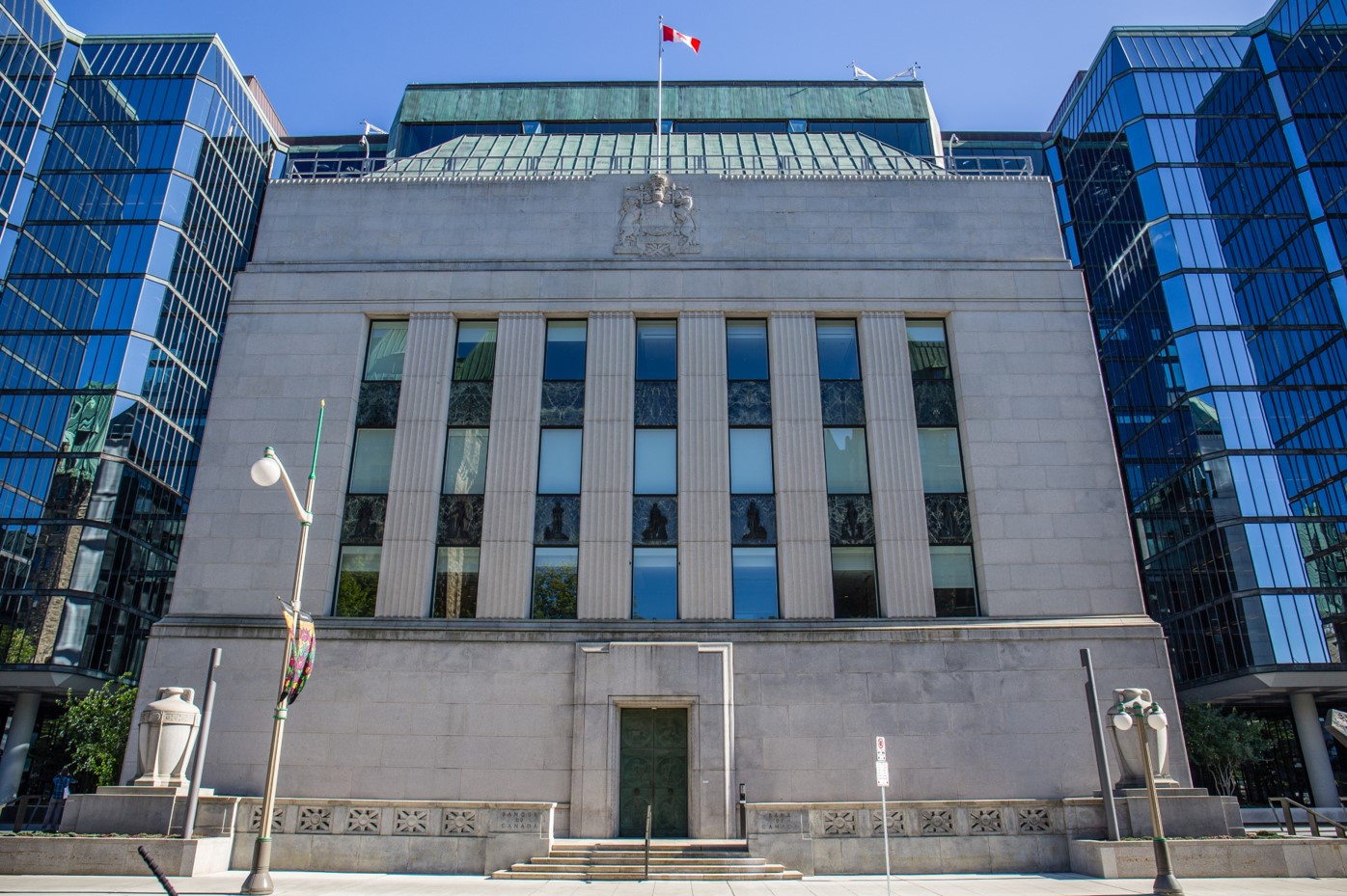
Bank of Canada decision — rates unchanged as policymakers look to balance risks
The Bank of Canada’s (BoC) policy-setting Governing Council opted to leave the policy overnight interest rate unchanged at 2.25% for the fifth consecutive meeting, as was universally expected by market watchers.
The communications shared today (June 10, 2026) accompanying the decision (the statement1 provided below for ease of reference) leaned dovish from my lens, somewhat pushing against the more hawkish tilt in the marketplace that continues to price in the prospect of rate hikes by year-end.
On the domestic economy, it was noted that economic growth in Q1 undershot the BoC’s expectations (-0.1% versus its forecast of +1.5% in the April Monetary Policy Report2) and while recent data suggest a rebound in the current quarter, “the economy is expected to remain in excess supply.” There was also a noteworthy addition to the final paragraph of the statement that “economic activity has been weak and uncertainty about US trade policy persists” (emphasis mine).
With respect to the job market, May’s strong Labour Force Survey3 was (rightly) discounted due to the volatile nature of the data and the fact that employment is “little changed since the start of the year”, while the unemployment rate has remained rangebound.
Finally, while headline inflation has increased due to the surge in energy prices (“as expected”), the BoC judges that “[s]o far, there has been limited evidence of broad-based pass-through of higher energy prices to other consumer prices” as “[m]easures of core inflation have moved down to around 2% and the share of CPI components growing above 3% is close to its historical average.” This does not exactly suggest there is a growing discomfort with inflation in Canada, and the BoC reiterated that it is “continuing to look through the war’s near-term impact on headline inflation” — though it “will not let higher energy prices become persistent inflation.”
The opening statement4 by BoC Governor Macklem to the post-decision press conference highlighted this “dilemma” for monetary policy at the moment. Easing monetary policy to support growth “increases the risk that inflation becomes persistent,” which they are explicitly against; however, raising rates to combat inflation “could further slow the economy” that is already seeing weakness in interest rate-sensitive areas of housing and business investment.
For now, it is judged that holding the policy rate at its current levels “balances those risks”, however, Macklem emphasized the need for policy to be “nimble” given that risks could shift, given that “uncertainty is unusually elevated” — “as the outlook evolves, we stand ready to respond as needed.”
Specifically, he noted that if the U.S. were to impose new trade restrictions on Canada, “we may need to cut the policy rate further to support economic growth”, while if higher energy prices “start leading to ongoing generalized inflation” there may be “a need for consecutive increases in the policy rate” — the need for “consecutive” hikes was a carryover from April. It is likely trying to communicate a move closer to restrictive territory from the current level, which is at the bottom of the estimated range for “neutral” (the April 29, 2026, Monetary Policy Report2 again showed that the BoC estimates the “neutral” range is 2.25% to 3.25%). Other issues such as the structural changes facing the economy, shifting trade relationships, the impact of artificial intelligence (AI) and changing demographics were flagged as complicating the assessment of the economy and determining the appropriate policy settings.
The bottom line is that the Bank of Canada is emphasizing the difficulties in determining the appropriate path for policy against a highly uncertain backdrop that is creating legitimate two-sided risks to the outlook. For the here and now, however, there appears to be more focus on the potential downside risks to growth than the upside risks to inflation, which suggests there is not quite the appetite for policy tightening that the market anticipates. Instead, the BoC appears likely to be patient and wait for any indications of knock-on price pressures — of which it is explicitly seeing “limited evidence” so far.
_____________
David Onyett-Jeffries
David Onyett-Jeffries is Vice President, Economics & Multi Asset Solutions, at Guardian Capital LP (GCLP). He provides macroeconomic guidance to GCLP and its affiliates. Additionally, he is a portfolio manager of GCLP’s multi-asset portfolios and funds and works closely with GCLP’s Directed Outcomes team.
1 Bank of Canada, Press Releases, Bank of Canada maintains the policy rate of 2¼%, June 10, 2026, https://www.bankofcanada.ca/2026/06/fad-press-release-2026-06-10/
2 Bank of Canada, Publications, Monetary Policy Report—April 2026, April 29, 2026, https://www.bankofcanada.ca/publications/mpr/mpr-2026-04-29/
3 Government of Canada, Statistics Canada, The Daily, Labour Force Survey, May 2026, June 5, 2026, https://www150.statcan.gc.ca/n1/daily-quotidien/260605/dq260605aeng.htm
4 Bank of Canada, Press, Speeches and appearances, Monetary Policy Decision Press Conference Opening Statement, June 10, 2026,
https://www.bankofcanada.ca/2026/06/opening-statement-2026-06-10/
STATEMENT
Bank of Canada maintains the policy rate at 2¼%
FOR IMMEDIATE RELEASE | Media Relations | Ottawa, Ontario
June 10, 2026
The Bank of Canada today held its target for the overnight rate at 2.25%, with the Bank Rate at 2.5% and the deposit rate at 2.20%.
The conflict in the Middle East is now in its fourth month. The resulting increases in energy prices and disruptions in global supply chains are weighing on global economic growth and pushing up inflation. At the same time, the US administration continues to propose new tariffs and trade policy uncertainty remains elevated.
In the United States, economic growth remains solid, supported by consumption and AI-related investment. In the euro area, growth is subdued, with higher energy prices weighing on activity. China’s economic growth continues to be supported by strong exports.
Canadian financial conditions have loosened since the April Monetary Policy Report. Global equity markets have been buoyant and bond yields remain volatile. The Canadian dollar has weakened against the US dollar and other currencies.
In Canada, GDP edged down by 0.1% in the first quarter, weaker than expected at the time of the April MPR. Consumer spending grew 1.4% but government spending unexpectedly declined. Housing activity also declined and business investment remained weak. Exports fell while imports rose strongly as inventories were rebuilt. Employment was up in May, but looking through monthly volatility, employment in Canada is little changed since the start of the year. The unemployment rate continues to fluctuate in the 6 ½%-7% range with the most recent reading at 6.6% in May.
Recent data suggests that growth will resume in the second quarter but, even with some rebound, the economy is expected to remain in excess supply.
As expected, CPI inflation rose in April, reaching 2.8%. The increase reflects energy prices, both higher oil prices and the impact of the elimination of the consumer carbon tax falling out of the 12-month rate of inflation. So far, there has been limited evidence of broad-based pass-through of higher energy prices to other consumer prices. Measures of core inflation have moved down to around 2% and the share of CPI components growing above 3% is close to its historical average. Food price inflation moderated but remains high, and shelter inflation continued to slow. With global oil prices still elevated—roughly $10 a barrel above our April MPR assumptions—total inflation is expected to hover around 3% in the near term before easing gradually towards 2%.
Against this overall backdrop, Governing Council decided to maintain the policy rate at 2.25%. Economic activity in Canada has been weak and uncertainty about US trade policy persists. The conflict in the Middle East is ongoing and oil prices remain elevated. Governing Council is continuing to look through the war’s near-term impact on headline inflation, but will not let higher energy prices become persistent inflation. As the outlook evolves, we stand ready to respond as needed. The Bank is committed to maintaining Canadians’ confidence in price stability through this period of global upheaval.
This commentary is for general informational purposes only and does not constitute investment, financial, legal, accounting, tax advice or a recommendation to buy, sell or hold a security. It shall under no circumstances be considered an offer or solicitation to deal in any product or security mentioned herein. It is only intended for the audience to whom it has been distributed and may not be reproduced or redistributed without the consent of Guardian Capital LP. This information is not intended for distribution into any jurisdiction where such distribution is restricted by law or regulation.
The opinions expressed are as of the date of publication and are subject to change without notice. Assumptions, opinions and estimates are provided for illustrative purposes only and are subject to significant limitations. Reliance upon this information is at the sole discretion of the reader. This document includes information concerning financial markets that were developed at a particular point in time. This information is subject to change at any time, without notice, and without update. This commentary may also include forward-looking statements concerning anticipated results, circumstances, and expectations regarding future events. Forward-looking statements require assumptions to be made and are, therefore, subject to inherent risks and uncertainties. There is significant risk that predictions and other forward-looking statements will not prove to be accurate. Investing involves risk. Equity markets are volatile and will increase and decrease in response to economic, political, regulatory and other developments. Investments in foreign securities involve certain risks that differ from the risks of investing in domestic securities. Adverse political, economic, social or other conditions in a foreign country may make the stocks of that country difficult or impossible to sell. It is more difficult to obtain reliable information about some foreign securities. The costs of investing in some foreign markets may be higher than investing in domestic markets. Investments in foreign securities are also subject to currency fluctuations. The risks and potential rewards are usually greater for small companies and companies located in emerging markets. Bond markets and fixed-income securities are sensitive to interest rate movements. Inflation, credit and default risks are all associated with fixed-income securities. Diversification may not protect against market risk and loss of principal may result. Index returns are for information purposes only and do not represent actual strategy or fund performance. Index performance returns do not reflect the impact of management fees, transaction costs or expenses. Certain information contained in this document has been obtained from external parties, which we believe to be reliable; however, we cannot guarantee its accuracy.
Guardian Capital LP is the manager and portfolio manager of the Guardian Capital Funds and Guardian Capital ETFs, with capabilities that span a range of asset classes, geographic regions and specialty mandates. Additionally, Guardian Capital LP manages portfolios for institutional clients such as defined benefit and defined contribution pension plans, insurance companies, foundations, endowments and investment funds. Guardian Capital LP is an indirect wholly owned subsidiary of Desjardins Global Asset Management Inc., which is part of the Desjardins Group. For further information on Guardian Capital LP, visit www.guardiancapital.com.
All trademarks, registered and unregistered, are owned by Guardian Capital Group Limited and are used under license.
Published: June 10, 2026