Midterm study notes
The U.S. midterm elections are now just two weeks away, so I wanted to circle back and give an update on how things currently stand.
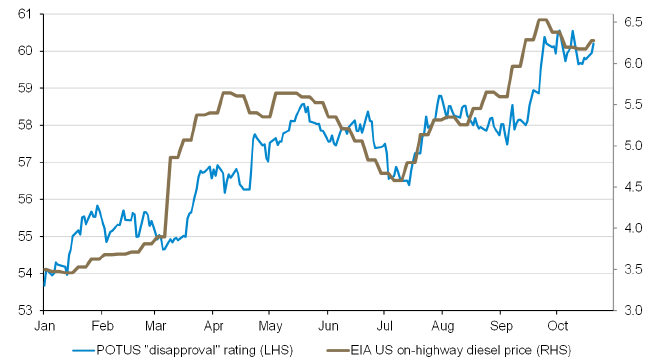
Since my last update on this topic (September 8), crude prices have moved higher and consequently taken refined product prices higher as well. As highlighted before, there is a tight correlation historically between energy prices and presidential approval ratings: the higher the costs for Americans to fill their tanks, the more they disapprove of the person in charge of the country.
U.S. Presidential “disapproval” ratings & diesel prices
(percent disapproving of the U.S. president) (U.S. dollars per gallon)
Source: Guardian Capital LP, based on data from Bloomberg and Silver Bulletin1 to October 20, 2026
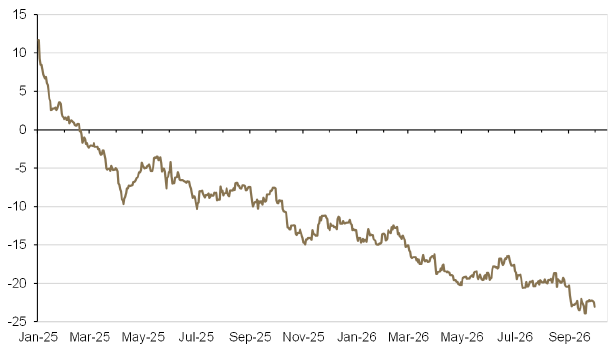
More broadly, the President’s net approval rating (share of those “approving” less “disapproving”) is plumbing its depths on the current term — given that a midterm election is viewed as a referendum on the Party in power, this is not a particularly positive omen for the Republicans.
U.S. Presidential net approval ratings
(share of Americans approving minus disapproving of the U.S. president; percentage points)
Source: Guardian Capital LP, based on data from Silver Bulletin to October 20, 2026
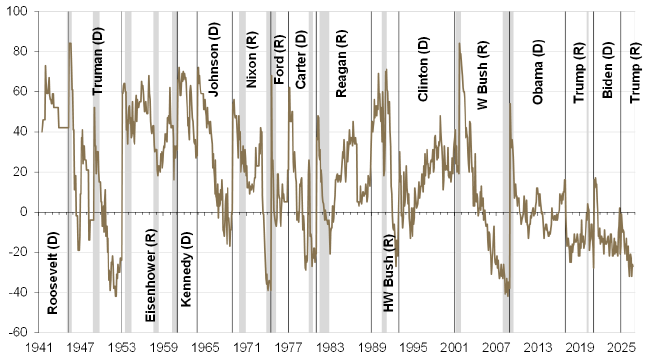
For those wanting a little more historical context here, the current net approval rating is the lowest of any President ahead of a midterm based on data since 1941 — and the President has the lowest net approval rating of any President at any time of their term outside of the tail-end of the Administrations of Truman, Nixon and W. Bush.
U.S. Presidential net approval ratings
(share of Americans approving minus disapproving of the U.S. president; percentage points)
Source: Guardian Capital LP, based on data from The American Presidency Project2 to September 2026
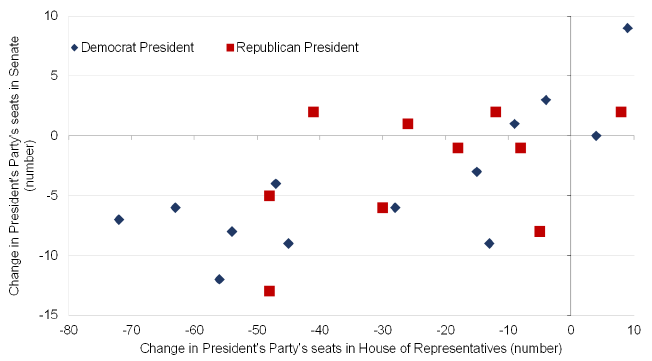
As a reminder, the President’s Party typically loses seats in the midterms in both the House of Representatives (where all 435 seats are up for vote) and Senate (where one-third of seats are typically up for grabs; this year there are 35 seats up due to special elections in Ohio and Florida) — there have only been three instances since 1934 where the President’s Party has gained seats in the House (FDR in 1934, Clinton in 1998 and W. Bush in 2002) while they have picked up seats in the Senate only seven times in these 23 midterms (FDR in 1934, JFK in 1962, Nixon in 1970, Reagan in 1982, W. Bush in 2002, Trump in 2018 and Biden in 2022). And historically, the less popular the President, the worse their Party performs.
President’s Party’s seat change in Congress in midterms
Source: Guardian Capital LP, based on data from The American Presidency Project2
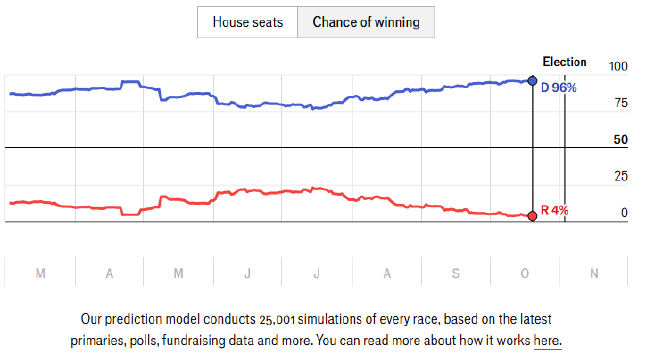
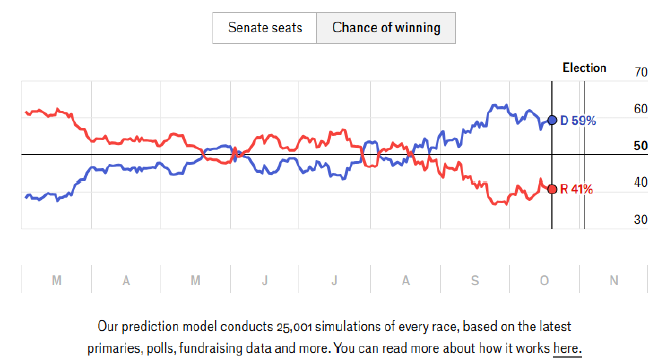
Perhaps unsurprisingly, current polling increasingly leans in favour of the Democrats making material seat pickups that shift the balance of power in Congress. Polling-based forecast models, such as those constructed by The Economist, give a 96% probability of Democrats taking the House3 and a 59% likelihood of gaining control of the Senate4.
The Economist prediction model, House
Source: Guardian Capital LP, based on data from The Economist3
The Economist prediction model, Senate
Source: Guardian Capital LP, based on data from The Economist4
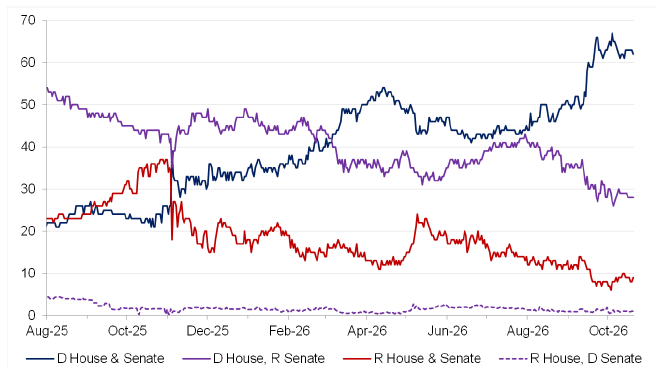
Similarly, for what it is worth, betting markets are also leaning heavily in favour of a Democrat sweep. For example, Polymarket5 is placing the highest odds on the Democrats ending up with control of both chambers (61%), with the Republicans losing the House but keeping the Senate as the next highest probability (28%); this is consistent with what is shown on6 other7 markets8.
Predicted balance of power after 2026 Midterm elections
(probability, percent)
Source: Guardian Capital LP, based on data from Polymarket9 to October 20, 2026
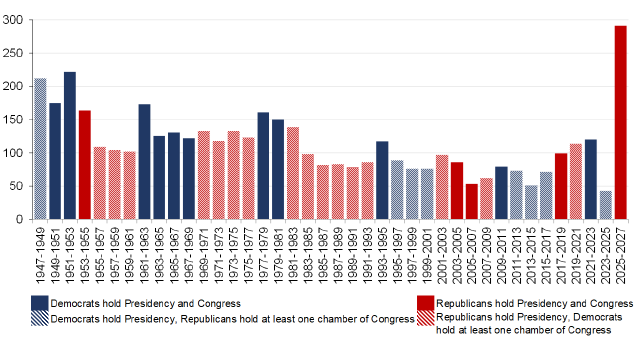
From a policy perspective, I noted previously that more work tends to get done when Congress is aligned with the President, as there is typically less pushback on an agenda. It is also interesting (and very relevant for the current Administration) that the use of Executive Orders tends to decline when Congress is not aligned with the President — there are avenues for Congress to override an Executive Order, including by passing legislation that invalidates it and/or refusing to provide funding needed to carry out the Order.
Executive Orders issued during Congressional Session
(number)
Source: Guardian Capital LP, based on data from the Federal Register10 to October 20, 2026
A gridlocked Congress — and one that has some ability to rein in the President — could prove beneficial in reducing the policy uncertainty that has been a constant over the last two years.
_____________
David Onyett-Jeffries
David Onyett-Jeffries is Vice President, Economics & Multi Asset Solutions, at Guardian Capital LP (GCLP). He provides macroeconomic guidance to GCLP and its affiliates. Additionally, he is a portfolio manager of GCLP’s multi-asset portfolios and funds and works closely with GCLP’s Directed Outcomes team.
¹ Silver Bulletin, Models & Forecasts, How popular is Donald Trump?, Silver Bulletin approval ratings for President Trump — and all presidents since Truman, Nate Silver and Eli McKown-Dawson, October 20, 2026, https://www.natesilver.net/p/trump-approval-ratings-nate-silver-bulletin
² The American Presidency Project, Statistics, Data, Presidential Job Approval–All Data, October 20, 2026, https://www.presidency.ucsb.edu/statistics/data/presidential-job-approval-all-data
³ The Economist, US Midterms 2026, Prediction Model, Democrats are heavy favourites to flip the House, October 20, 2026, https://www.economist.com/interactive/2026/us-midterms/prediction-model/house/
4 The Economist, US Midterms 2026, Prediction Model, A friendly map may not be enough for Republicans to hold the Senate, October 20, 2026, https://www.economist.com/interactive/2026/us-midterms/prediction-model/senate
5 Polymarket, Politics, Midterms, House, 2026 Midterms: Balance of Power, October 20, 2026, https://polymarket.us/event/balpow-2026-11-03
6 PredictIt.org, Markets, What will be the balance of power in Congress after the 2026 election?, October 20, 2026, https://www.predictit.org/markets/detail/8600/What-will-be-the-balance-of-power-in-Congress-after-the-2026-election
7 Kalshi, Markets, Senate, 2026 midterm predictions, Midterms: Congress Balance of Power?, October 26, 2026, https://kalshi.com/markets/kxbalancepowercombo/congress-balance-of-power-combo/kxbalancepowercombo-27feb
8 Robin Hood, Prediction markets, Midterms, Control of Congress, 2026 Congressional Balance of Power, October 20, 2026, https://robinhood.com/us/en/prediction-markets/elections/events/2026-congressional-balance-of-power-nov-03-2026/
9 Polymarket, Politics, US Election, Balance of Power: 2026 Midterms, October 20, 2026, https://polymarket.com/event/balance-of-power-2026-midterms
10 National Archives, Federal Register, Reader Aids :: Insight into the FR Ecosystem, Executive Orders, October 20, 2026, https://www.federalregister.gov/presidential-documents/executive-orders
This commentary is for general informational purposes only and does not constitute investment, financial, legal, accounting, tax advice or a recommendation to buy, sell or hold a security. It shall under no circumstances be considered an offer or solicitation to deal in any product or security mentioned herein. It is only intended for the audience to whom it has been distributed and may not be reproduced or redistributed without the consent of Guardian Capital LP. This information is not intended for distribution into any jurisdiction where such distribution is restricted by law or regulation.
The opinions expressed are as of the date of publication and are subject to change without notice. Assumptions, opinions and estimates are provided for illustrative purposes only and are subject to significant limitations. Reliance upon this information is at the sole discretion of the reader. This document includes information concerning financial markets that were developed at a particular point in time. This information is subject to change at any time, without notice, and without update. This commentary may also include forward-looking statements concerning anticipated results, circumstances, and expectations regarding future events. Forward-looking statements require assumptions to be made and are, therefore, subject to inherent risks and uncertainties. There is significant risk that predictions and other forward-looking statements will not prove to be accurate. Investing involves risk. Equity markets are volatile and will increase and decrease in response to economic, political, regulatory and other developments. Investments in foreign securities involve certain risks that differ from the risks of investing in domestic securities. Adverse political, economic, social or other conditions in a foreign country may make the stocks of that country difficult or impossible to sell. It is more difficult to obtain reliable information about some foreign securities. The costs of investing in some foreign markets may be higher than investing in domestic markets. Investments in foreign securities are also subject to currency fluctuations. The risks and potential rewards are usually greater for small companies and companies located in emerging markets. Bond markets and fixed-income securities are sensitive to interest rate movements. Inflation, credit and default risks are all associated with fixed-income securities. Diversification may not protect against market risk and loss of principal may result. Index returns are for information purposes only and do not represent actual strategy or fund performance. Index performance returns do not reflect the impact of management fees, transaction costs or expenses. Certain information contained in this document has been obtained from external parties, which we believe to be reliable; however, we cannot guarantee its accuracy.
Guardian Capital LP is the manager and portfolio manager of the Guardian Capital Funds and Guardian Capital ETFs, with capabilities that span a range of asset classes, geographic regions and specialty mandates. Additionally, Guardian Capital LP manages portfolios for institutional clients such as defined benefit and defined contribution pension plans, insurance companies, foundations, endowments and investment funds. Guardian Capital LP is an indirect wholly owned subsidiary of Desjardins Global Asset Management Inc., which is part of the Desjardins Group. For further information on Guardian Capital LP, visit www.guardiancapital.com.
Published: October 20, 2026