The Bank of Canada – A pre-emptive strike against upside risks to inflation
The Bank of Canada (BoC) decided to raise its policy overnight interest rate target this morning [October 28, 2026] by 25 basis points to 2.50%, the first hike since July 2023. The move makes good on the hawkish comments from Governor Macklem on October 171 that saw a sharp repricing of rates in the market — the market-implied odds of an October hike jumped from 30% to 85%; forecasters remained split on whether the Bank would move today or hold steady ahead of today’s decision.
Bank of Canada overnight policy rate
(percent)
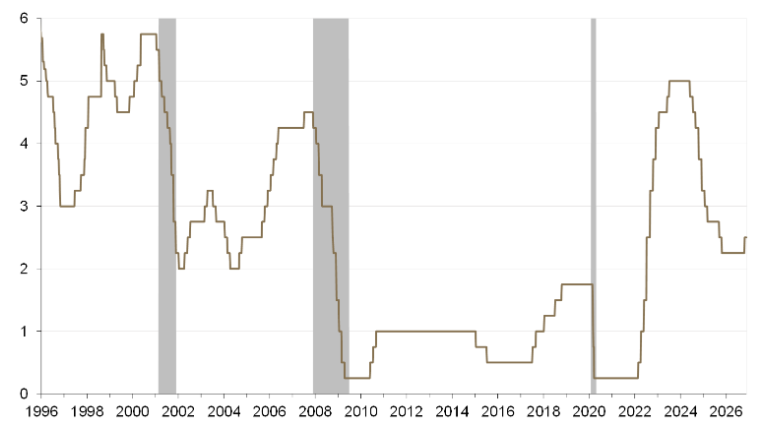
Shaded regions represent periods of U.S. recession; source: Guardian Capital LP, based on data from Bloomberg to October 28, 2026
As per the statement2 accompanying today’s decision (provided below for ease of reference), while a “broad set of indicators continue to point to some excess supply in the economy”, the upward revision to inflation expectations across the forecast horizon (seen in the updated Monetary Policy Report3 released in tandem with today’s decision) due to “higher-for-longer energy prices” and the anticipation of “increased pass-through” of higher input costs by businesses, gave cause for the central bank to tighten its policy stance “to reduce the risk that continuing high energy prices spread broadly to the prices of other goods and services”.
So, call it a pre-emptive strike, enabled by the better-than-expected domestic economic resilience (growth forecasts saw upward revisions across the forecast horizon as well). Indeed, Governor Macklem, in the opening statement4 to his post-meeting presser, noted that for the here-and-now, inflationary pressures have been “concentrated in energy prices and services that rely heavily on energy inputs, such as airfares” and measures of core inflation remain close to the BoC’s 2% target.
In terms of forward guidance, the BoC noted that “there could be a need to increase the policy rate further” given the upside risks to inflation but cautioned that the policy-setting Governing Council will “proceed carefully” and “take future decisions one meeting at a time” given “uncertainties” around the outlook due to “developments in the Middle East and businesses’ responses to cost pressures”.
Accordingly, focus will turn to any indications that these upside risks to underlying price pressures are actually materializing. Should evidence begin to mount—which is unlikely in the near term from my lens, creating low odds of another move at the next meeting on December 9, 2026—and economic momentum is sustained, the BoC will likely hike again next year.
That said, I would argue that the persistence of an output gap (estimated to range from -1.25% to -0.25% in Q3, consistent with what was assumed in the July MPR5) does not appear to support the market’s pricing in an additional 75 basis points worth of tightening by this time next year, that would take policy to the “restrictive” side of the dial — the BoC again estimated the “nominal neutral interest rate” to be at the midpoint of the 2.25% to 3.25% range.
_____________
David Onyett-Jeffries
David Onyett-Jeffries is Vice President, Economics & Multi Asset Solutions, at Guardian Capital LP (GCLP). He provides macroeconomic guidance to GCLP and its affiliates. Additionally, he is a portfolio manager of GCLP’s multi-asset portfolios and funds and works closely with GCLP’s Directed Outcomes team.
STATEMENT
Bank of Canada raises the policy rate by 25 basis points to 2½%
FOR IMMEDIATE RELEASE | Media Relations | Ottawa, Ontario
October 28, 2026
The Bank of Canada today increased its target for the overnight rate by 25 basis points to 2.5%, with the Bank Rate at 2.75% and the deposit rate at 2.45%.
Since the July Monetary Policy Report, global economic activity has remained resilient, despite higher energy prices. In the United States, the economy continues to grow at a robust pace, supported by consumer spending and AI-related investment. Growth in the euro area has been resilient and broad-based. After slowing in the second quarter, Chinese growth rebounded in the third quarter, owing to strength in exports and a pickup in fiscal spending. With persistently elevated oil prices and refinery margins, inflation has risen in most countries.
Given the ongoing resilience of the global economy, the Bank has revised up global GDP growth slightly to 3.1% in 2026, while growth in 2027 and 2028 remains unchanged from the July projection at 3.2%.
Global financial conditions have tightened since July. Advanced economy sovereign bond yields are higher. Equity and credit markets have been volatile due to uncertainty about the outlook for the AI sector. The Canadian dollar had weakened somewhat on US-dollar strength but has since recovered to around 71 cents – the same as assumed in the July Report.
Growth picked up in Canada through the middle of the year. GDP growth was 3.3% in the second quarter, and recent indicators point to growth of about 2% in the third quarter. This is stronger than expected in the July Report. Consumer spending has been solid, even with slow population growth. Business investment rebounded, reflecting oil and gas sector activity and spending on machinery and equipment. Despite ongoing weakness in sectors affected by US tariffs, exports overall have strengthened, owing to robust US demand, higher energy production and increasing signs that businesses are adapting to the changing trade environment. The unemployment rate has been around 6½% for several months. A broad set of indicators continue to point to some excess supply in the economy.
Owing to new US tariffs, growth is expected to slow in the fourth quarter of 2026, before picking up again in 2027. This rebound is supported by business investment, exports and fiscal measures. Consumption growth is expected to moderate and housing to remain relatively weak.
The Canadian economy is expected to grow 1% in 2026, and 2% in 2027 and 2028. This is a somewhat stronger overall growth projection than the July Report. This forecast is still subject to considerable uncertainty, particularly regarding Canada-US trade relations.
Given persistently high oil prices, CPI inflation has been around 3% since April and is expected to rise to about 3½% by the end of the year. Excluding gasoline, inflation was 2.2% in September and measures of core inflation remain close to 2%. But cost pressures are building, with high fuel prices raising the costs of production and transportation. Imported industrial and electronics input prices have also increased. While businesses have mostly absorbed higher input costs so far, Bank surveys suggest cost pass-through will increase over the next year. Near-term household and business inflation expectations have risen, while longer-term inflation expectations remain well anchored.
The conflict in the Middle East is now in its eighth month and there is no clear path to resolution. The combination of higher-for-longer energy prices and increased pass-through adds to the persistence of inflation in the projection. CPI inflation is expected to average 3% in 2027, a percentage point above the July projection, then come down to 2% in the middle of 2028. The main sources of uncertainty around this forecast are developments in the Middle East and businesses’ responses to cost pressures.
In the outlook, inflation is higher and more persistent than in the July Report. Growth has picked up this year and is expected to recover further. Against this backdrop, Governing Council decided to increase the policy rate to reduce the risk that continuing high energy prices spread broadly to the prices of other goods and services. There could be a need to increase the policy rate further, but given uncertainties, Governing Council agreed to proceed carefully. The Bank remains committed to maintaining Canadians’ confidence in price stability.
1 Bank of Canada, Press, Media Advisories, Media roundtable with Governor Macklem, October 17, 2026, https://www.bankofcanada.ca/2026/10/media-roundtable-governor-macklem-2026-10-17/
2 Bank of Canada, Press Releases, Bank of Canada raises the policy rate by 25 basis points to 2½%, October 28, 2026, https://www.bankofcanada.ca/2026/10/fad-press-release-2026-10-28/
3 Bank of Canada, Monetary Policy Report October 2026, October 28, 2026, https://static.bankofcanada.ca/uploads/pdf/mpr-2026-10-28.pdf
4 Bank of Canada, Press, Speeches and appearances, Monetary Policy Report Press Conference Opening Statement, Tiff Macklem, October 28, 2026,
https://www.bankofcanada.ca/2026/10/opening-statement-2026-10-28/
5 Bank of Canada, Monetary Policy Report—July 2026, July 15, 2026, https://www.bankofcanada.ca/publications/mpr/mpr-2026-07-15/
This commentary is for general informational purposes only and does not constitute investment, financial, legal, accounting, tax advice or a recommendation to buy, sell or hold a security. It shall under no circumstances be considered an offer or solicitation to deal in any product or security mentioned herein. It is only intended for the audience to whom it has been distributed and may not be reproduced or redistributed without the consent of Guardian Capital LP. This information is not intended for distribution into any jurisdiction where such distribution is restricted by law or regulation.
The opinions expressed are as of the date of publication and are subject to change without notice. Assumptions, opinions and estimates are provided for illustrative purposes only and are subject to significant limitations. Reliance upon this information is at the sole discretion of the reader. This document includes information concerning financial markets that were developed at a particular point in time. This information is subject to change at any time, without notice, and without update. This commentary may also include forward-looking statements concerning anticipated results, circumstances, and expectations regarding future events. Forward-looking statements require assumptions to be made and are, therefore, subject to inherent risks and uncertainties. There is significant risk that predictions and other forward-looking statements will not prove to be accurate. Investing involves risk. Equity markets are volatile and will increase and decrease in response to economic, political, regulatory and other developments. Investments in foreign securities involve certain risks that differ from the risks of investing in domestic securities. Adverse political, economic, social or other conditions in a foreign country may make the stocks of that country difficult or impossible to sell. It is more difficult to obtain reliable information about some foreign securities. The costs of investing in some foreign markets may be higher than investing in domestic markets. Investments in foreign securities are also subject to currency fluctuations. The risks and potential rewards are usually greater for small companies and companies located in emerging markets. Bond markets and fixed-income securities are sensitive to interest rate movements. Inflation, credit and default risks are all associated with fixed-income securities. Diversification may not protect against market risk and loss of principal may result. Index returns are for information purposes only and do not represent actual strategy or fund performance. Index performance returns do not reflect the impact of management fees, transaction costs or expenses. Certain information contained in this document has been obtained from external parties, which we believe to be reliable; however, we cannot guarantee its accuracy.
Guardian Capital LP is the manager and portfolio manager of the Guardian Capital Funds and Guardian Capital ETFs, with capabilities that span a range of asset classes, geographic regions and specialty mandates. Additionally, Guardian Capital LP manages portfolios for institutional clients such as defined benefit and defined contribution pension plans, insurance companies, foundations, endowments and investment funds. Guardian Capital LP is an indirect wholly owned subsidiary of Desjardins Global Asset Management Inc., which is part of the Desjardins Group. For further information on Guardian Capital LP, visit www.guardiancapital.com.
Published: October 28, 2026