
Commentary
After declining almost uninterrupted for four decades, global interest rates have risen sharply from their pandemic era lows. Recent increases over the last few months have pushed government bond yields to their highest level in more than two decades, and in some cases, even longer.
10-year sovereign bond yields
(percent, U.S. dollar basis)
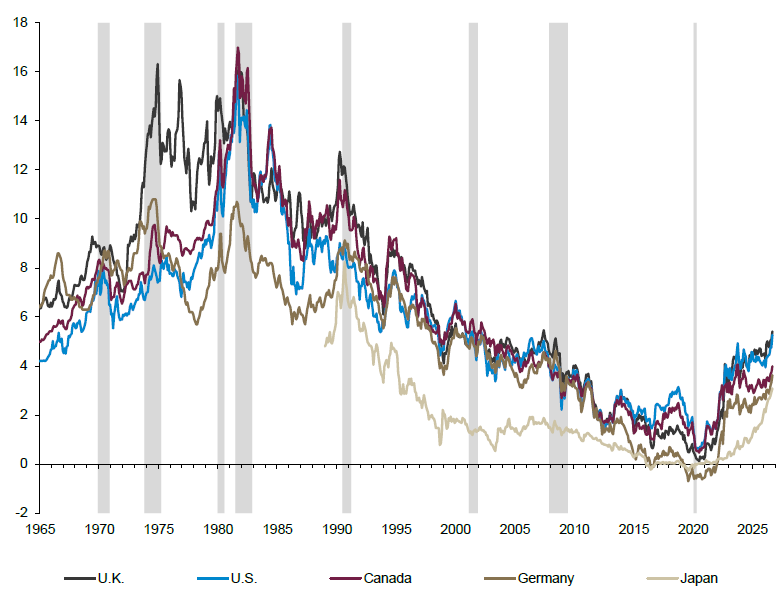
For many investors, today’s elevated interest rates represent a significant change from what they have experienced throughout most of their adult lives. Since the Global Financial Crisis in 2008/2009, policy rates have generally remained near zero, and the benchmark 10-year U.S. Treasury yield has not traded above 5% since June 2007. At that time, the median Millennial, now part of the largest demographic cohort, was just 18 years old. Accordingly, there are reasonable questions and concerns for investors regarding what higher interest rates may mean for financial markets and the broader economy.
As a starting point, it is worthwhile to explain why interest rates are where they are now.
Despite the many uncertainties that have plagued the economic outlook over the last six years, economic momentum remains on solid footing worldwide. Household net worth across Developed Markets is at all-time highs, supporting consumer spending and helping keep job markets tight, which in turn reinforces consumer demand. Concurrently, businesses have increased capital expenditures as they invest to capitalize on the opportunities presented by the ongoing technological and information revolution. These positive economic impacts are further compounded by the effects of substantial government spending and investment initiatives.
The resulting robust demand has placed upward pressure on prices. In an environment where the supply-side of the economy can grow sufficiently to keep pace with demand, these inflationary pressures would likely be contained. As it stands, however, limited inventories and capacity constraints, particularly in technology-related areas of production, have contributed to rising costs that are filtering through the broader economy.
Furthermore, the ongoing wars in Ukraine and the Middle East have disrupted the flow of key commodities and natural resources. Against a backdrop of strong underlying demand, these supply disruptions have contributed to rising commodity prices, particularly in energy markets. Higher energy costs have broad implications, affecting not only production processes, but transportation and logistics costs throughout global supply chains.
Add in the impact of increased trade barriers tied to U.S. economic policy changes and the net impact is that global inflation, the generalized increase in prices, has been persistently running above desired rates and is expected to continue to do so, eroding purchasing power and creating potential longer-term damage to economic stability.
In response, central banks have become increasingly focused on doing their part to rein in inflation, which means tightening monetary policy by raising short-term interest rates. Higher rates mean higher costs of capital which can restrain borrowing, temper demand growth and ease pressure on prices. Several major central banks have increased their policy rates, and more hikes are expected by more central banks in the months to come, which is putting upward pressure on longer-term market interest rates.
At the same time, governments are issuing significant amounts of debt to finance their hefty spending plans and ongoing fiscal deficits. The Organisation for Economic Cooperation and Development (OECD) estimates that governments will issue an additional US$4 trillion in net new debt this year, in addition to approximately US$14 trillion of required refinance for existing maturing liabilities. Meanwhile, “hyperscalers”, those huge cloud computing and storage companies, are increasingly tapping into debt markets to fund their massive capital spending plans. This significant increase in bond issuance, combined with uncertainty surrounding future public and private sector spending, has placed further upward pressure on market yields.
Higher interest rates are clearly less than ideal for borrowers, including households, businesses, and governments, as they make the costs of carrying new and refinanced debt more onerous. The prospect of rates remaining elevated, or moving higher still, also presents risks for economic growth, especially in interest-rate sensitive sectors such as real estate.
As such, higher rates typically serve as a headwind for equities. They increase financing costs for businesses, can weigh on economic growth and corporate revenues, and generally lead investors to lower valuation adjustments.1
That said, the current level of interest rates and the expectation of further increases are in part a product of a global economy that has remained resilient and there is no reason to anticipate that momentum will soon be derailed. There is plenty of historic precedence for the economy and markets performing well in a world with non-zero interest rates, even if it is novel to a large swath of the population.
Further, higher rates benefit lenders, savers, and fixed income investors by increasing the income generated on their capital. Indeed, the current market environment is one in which fixed income securities are arguably the most attractive they have been in decades, particularly as a going share of the population approaches retirement and seeks reliable sources of income. This stands in sharp contrast to late 2020, when nearly one-third of the global bond market was trading at negative yields, effectively locking investors into losses if held to maturity.
Equity Commentary
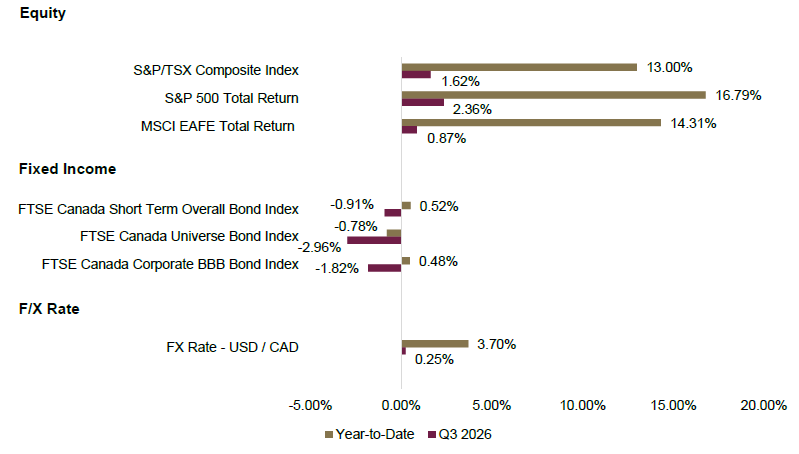
The third quarter of 2026 delivered modest gains across the major developed equity markets, although the advance was narrow and the path more turbulent compared with the sharp rebound of the second quarter. In U.S. dollar terms, the MSCI EAFE Index of European and Asian markets rose 0.9% and the S&P 500 Index gained 2.3%. The Canadian market rose 1.6%, slightly behind the U.S., largely due to differences in sector composition. U.S. gains came mostly from large technology and semiconductor companies tied to artificial intelligence, an area where the Canadian market has relatively limited exposure. Meanwhile, Canadian banks, which represent the largest sector of the TSX, came under pressure late in the quarter as bond yields moved higher. A weaker Loonie widened the gap further by boosting the value of U.S. returns for Canadian investors.
With three months to go in the year, year-to-date developed-market equity returns in 2026 remain solidly positive. In Canadian dollar terms, the S&P 500 Index is up 16.8%, the MSCI EAFE Index is up 14.3% and the S&P/TSX Composite index up 13.0%. Artificial intelligence remains one of the market’s dominant themes, with leadership once again concentrated this quarter in the largest technology and semiconductor companies. This follows a stronger first half of the year when market gains were more broadly distributed across sectors. The concentration was stark in September, when Information Technology and Communication Services were the only S&P 500 sectors to generate positive returns. Meanwhile, rising bond yields continued to weigh on more interest-rate-sensitive sectors such as Real Estate, Utilities, Consumer Staples, and Financials. While these sectors have been among the weaker parts of the market this year, their lower valuations may present attractive opportunities for long-term investors.
The sharp global market selloff in March, triggered by the outbreak of war with Iran, now feels increasingly distant following the subsequent recovery. Yet that resilience has come despite a difficult backdrop. Energy prices remain elevated, inflation has proven stubborn, and global bond yields have climbed to multi-decade highs, raising borrowing costs for households and businesses. Escalating trade tensions between Canada and the U.S. have added further uncertainty for a Canadian economy already struggling with growth challenges.
In response, central banks have shifted from an easing to a tightening stance. The U.S. Federal Reserve raised interest rates in September for the first time since 2023, while the Bank of Canada has signaled growing concern about upside risks to inflation, suggesting the potential for further policy tightening. While equity market performance in the coming months will reflect this confluence of factors, valuations remain reasonable across many sectors, particularly among high-quality businesses, providing a supportive backdrop for long-term investors.
Fixed Income Commentary
It was another challenging quarter for fixed income markets as solid growth momentum and persistent concerns about inflation, in no small way exacerbated by the renewed upward pressure on energy prices following the collapse of negotiations and ongoing war in the Middle East, drove notably hawkish turns from global central banks over the summer. The likes of the U.S. Federal Reserve, European Central Bank, Bank of Japan, and Reserve Bank of Australia, all raised their policy interest rates in the third quarter in response to inflationary pressures. At the same time, markets increasingly priced in additional hikes from these and other monetary policy authorities in the months ahead, including the Bank of Canada, which chose to leave rates unchanged during the period.
Upward pressure on market interest rates was further compounded by expectations for a surge in debt issuance from global governments looking to finance their sizable fiscal deficits, heightening investor concerns regarding fiscal sustainability. Concurrently, corporations, particularly the “hyperscalers”, are increasingly tapping the market to fund substantial capital expenditure plans, contributing to the global supply of securities and exerting further upward pressure on yields.
As a result, government bond yields rose significantly over the quarter and ended September at their highest levels in two decades. The sharp rise in yields drove a broad decline in fixed income markets, as bond prices move inversely with yields. The broad-based FTSE Canada Universe Bond Index dropped 3.0% in the third quarter, marking its worst quarterly performance in three years (and sixth worst quarter of the last 20 years). More rate-sensitive segments of the market underperformed, with the FTSE Canada Long-Term Bond Index falling 6.3% and the FTSE Canada Government Bond Index declining 3.2%. Short-Term and Corporate Bond Indexes fared somewhat better, declining 0.9% and 2.1%, respectively, but still finished the period in the red.
Looking ahead, in the absence of a sustained resolution to the war in Iran that sees the resumption of traffic through the Strait of Hormuz that results in a material decline in energy prices, there is little reason to anticipate a near-term turn of fortunes in the bond market. Upside risks to inflation and sustained growth momentum appear likely to keep the hawkish bias in place at central banks, which at a minimum suggests policy rates staying at their current levels for longer.
From an investor standpoint, however, while the near-term upside risks for rates and the low level of credit spreads are less than ideal, the all-in yield on offer in fixed income securities makes the asset class arguably the most attractive it has been in decades from a return and balanced portfolio diversification perspective.
Market Indices Performance (C$ – September 30, 2026)
1 Higher interest rates mean higher discount rates that reduce the present value of future cash flows/earnings; assuming that valuation multiples such as price-to-earnings ratios stay constant, that implies declining prices.
Guardian Partners Inc. (“GPI”) is providing, with permission, this market commentary, portions of which were co-authored by Guardian Capital LP (“GCLP”). GCLP is an affiliate of GPI and is both a sub-advisor to certain GPI accounts and the Advisor and Fund Manager to the Guardian Capital LP investment funds offered to GPI clients.
This commentary is for general informational purposes only and does not constitute investment, financial, legal, accounting, tax advice or a recommendation to buy, sell or hold a security. It shall under no circumstances be considered an offer or solicitation to deal in any product or security mentioned herein. It is only intended for the audience to whom it has been distributed and may not be reproduced or redistributed without the consent of GPI. This information is not intended for distribution into any jurisdiction where such distribution is restricted by law or regulation.
The opinions expressed are as of the published date and are subject to change without notice. Assumptions, opinions and estimates are provided for illustrative purposes only and are subject to significant limitations. Reliance upon this information is at the sole discretion of the reader. This document includes information and commentary concerning financial markets that were developed at a particular point in time. This information and commentary are subject to change at any time, without notice, and without update. This commentary may also include forward-looking statements concerning anticipated results, circumstances, and expectations regarding future events. Forward-looking statements require assumptions to be made and are, therefore, subject to inherent risks and uncertainties. There is a significant risk that predictions and other forward-looking statements will not prove to be accurate. Investing involves risk. Equity markets are volatile and will increase and decrease in response to economic, political, regulatory and other developments. Investments in foreign securities involve certain risks that differ from the risks of investing in domestic securities. Adverse political, economic, social or other conditions in a foreign country may make the stocks of that country difficult or impossible to sell. It is more difficult to obtain reliable information about some foreign securities. The costs of investing in some foreign markets may be higher than investing in domestic markets. Investments in foreign securities are also subject to currency fluctuations. The risks and potential rewards are usually greater for small companies and companies located in emerging markets. Bond markets and fixed-income securities are sensitive to interest rate movements. Inflation, credit and default risks are also associated with fixed-income securities. Diversification may not protect against market risk, and loss of principal may result. This commentary is provided for educational purposes only. It is not offered as investment advice and does not account for individual investment objectives, risk tolerance, financial situation or the timing of any transaction in any specific security or asset class. Certain information contained in this document has been obtained from external parties, which we believe to be reliable; however, we cannot guarantee its accuracy. These sources include Bloomberg, Bank of Canada and National Bank Independent Network for the relevant periods cited in this commentary.