
Recent years have seen the Baby Boom generation (which includes those born between 1946 and 1964) be displaced by Millennials (born between 1981 and 1996) as the largest population cohort in the U.S. (around 20201) and Canada (in 20242) for the first time since the late 1950s.
While Millennials (now aged between 30 and 45) have larger numbers overall and within the workforce, their economic clout pales in comparison to their older counterparts.
For example, it is estimated3 that the aggregate household net worth of the Baby Boomers is US$90 trillion, nearly five times that of the Millennials (US$19 trillion), while the oft-forgotten GenX (born between 1965 and 1980) have an estimated US$46 trillion in accumulated wealth and the dwindling Silent Generation and older (born before 1946) are next with US$21 trillion.
Generational wealth over time
(aggregate net worth by generational cohort, U.S.; trillions of U.S. dollars)
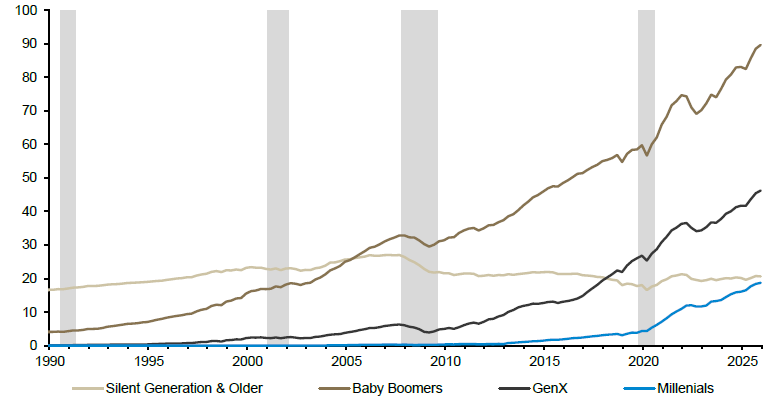
Thanks to strength in housing and financial markets, these older cohorts’ wealth has continued to rise even as they have increasingly retired and entered the “decumulation” phase of their lives. The resulting “wealth effect” has served as a tremendous boost to consumption in recent years, particularly in areas such as travel and leisure. That impact is likely to continue to be felt for decades to come as people are living longer and healthier lives now than in previous generations (though health care spending will likely play a bigger role).
At the same time, the increased longevity and economic engagement of the older generations means that they are maintaining control of wealth that was previously transferred to younger generations earlier on in their lives and at a time when it was most beneficial. Those inheritances helped older cohorts with the purchase of starter homes and offset the added costs of the early stages of having a family.
Interestingly, though, while the delay in the long-heralded “Great Wealth Transfer” has resulted in some relative headwinds for younger cohorts relative to prior generations (housing affordability being at the top of that list), when adjusting the wealth data for the size of the cohorts and inflation, the average Millennial is actually notably better off right now in “real” terms than previous generations were at the same point in their lives (in general, every generation has gotten wealthier).
Generational wealth by age cohort
(average household net worth per person by generational cohort, U.S.; thousands of 2025 U.S. dollars*)
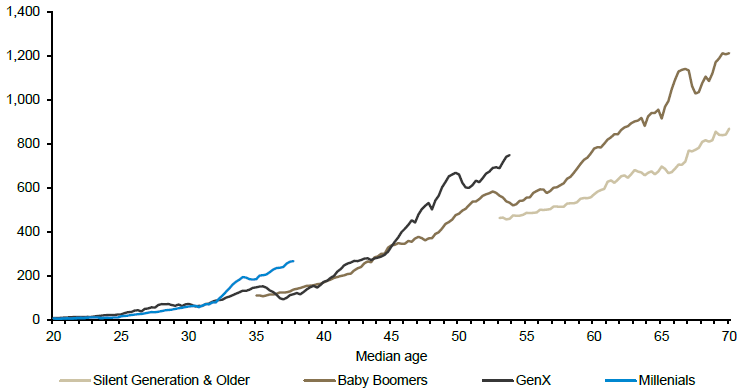
Millennials hold comparatively less exposure to “real” assets like real estate and durable goods compared to other generations at similar stages but have more exposure to financial markets at a time when markets have generally performed well throughout their investing years (whereas GenX had to deal with the Tech Wreck and Financial Crisis out of the gate in the “accumulation” phases of their lives).
The population living longer, and staying more involved in the economy than prior generations, means that older generations will remain more important to the outlook than previously was the case. This will impede the “takeover” by younger generations (such as delaying business succession plans, which has resulted in less equity in private businesses on balance sheets and keeping housing markets tight). Other cohorts appear capable of holding their own thanks to good relative financial footing that will eventually be lifted when the significant amount of wealth ultimately does get transferred.
1Pew Research Center, Short Reads, Millennials overtake Baby Boomers as America’s largest generation, April 28, 2020, https://www.pewresearch.org/short-reads/2020/04/28/millennials-overtake-baby-boomers-as-americas-largest-generation/
2 Government of Canada, Statistics Canada. The Daily, Millennials now outnumber baby boomers in Canada, February 21, 2024, https://www150.statcan.gc.ca/n1/daily-quotidien/240221/dq240221a-eng.htm
3 Board of Governors of the Federal Reserve System, Data Z.1-Financial Accounts Enhanced Financial Accounts DFA: Distributional Financial Accounts
Guardian Partners Inc. (“GPI”) is providing, with permission, this market commentary, which was co-authored by Guardian Capital LP (“GCLP”) and GPI. GCLP is an affiliate of GPI, and is both a sub-advisor to certain GPI accounts and the Advisor and Fund Manager to the GCLP investment funds offered to GPI clients.
This commentary is for general informational purposes only and does not constitute investment, financial, legal, accounting, tax advice or a recommendation to buy, sell or hold a security. It shall under no circumstances be considered an offer or solicitation to deal in any product or security mentioned herein. It is only intended for the audience to whom it has been distributed and may not be reproduced or redistributed without the consent of GPI. This information is not intended for distribution into any jurisdiction where such distribution is restricted by law or regulation.
The opinions expressed are as of the published date and are subject to change without notice. Assumptions, opinions and estimates are provided for illustrative purposes only and are subject to significant limitations. Reliance upon this information is at the sole discretion of the reader. This document includes information and commentary concerning financial markets that were developed at a particular point in time. This information and commentary are subject to change at any time, without notice, and without update. This commentary may also include forward-looking statements concerning anticipated results, circumstances, and expectations regarding future events. Forward-looking statements require assumptions to be made and are, therefore, subject to inherent risks and uncertainties. There is a significant risk that predictions and other forward-looking statements will not prove to be accurate. Investing involves risk. Equity markets are volatile and will increase and decrease in response to economic, political, regulatory and other developments. Investments in foreign securities involve certain risks that differ from the risks of investing in domestic securities. Adverse political, economic, social or other conditions in a foreign country may make the stocks of that country difficult or impossible to sell. It is more difficult to obtain reliable information about some foreign securities. The costs of investing in some foreign markets may be higher than investing in domestic markets. Investments in foreign securities are also subject to currency fluctuations. The risks and potential rewards are usually greater for small companies and companies located in emerging markets. Bond markets and fixed-income securities are sensitive to interest rate movements. Inflation, credit and default risks are also associated with fixed-income securities. Diversification may not protect against market risk, and loss of principal may result. This commentary is provided for educational purposes only. It is not offered as investment advice and does not account for individual investment objectives, risk tolerance, financial situation or the timing of any transaction in any specific security or asset class. Certain information contained in this document has been obtained from external parties, which we believe to be reliable; however, we cannot guarantee its accuracy. These sources include Bloomberg, Bank of Canada and National Bank Independent Network for the relevant periods cited in this commentary.
Published: June 3, 2026